About Polycarbonaat (PC)
All About Polycarbonaat (PC)Transparant en bijzonder slagvast
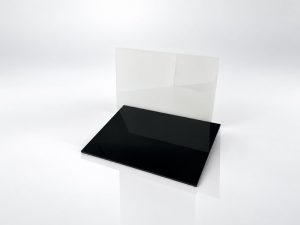
Polycarbonaat (PC), bekend onder merknamen zoals IMPEX®, Lexan™ en Makrolon®, combineert een hoge transparantie met een zeer hoge slagvastheid. Hierdoor is het geschikt voor toepassingen waarbij goed doorzicht en bescherming belangrijk zijn, zoals machineafschermingen, beschermkappen en beglazing.
Plano Plastics levert onder andere IMPEX®. Deze platen laten zich goed zagen, frezen en boren. De standaard uitvoering kan daarnaast koud worden gebogen of warm worden vervormd. Voor thermoformen is voordrogen nodig.
Standaard IMPEX® is volgens de fabrikant geschikt voor continu gebruik tot 115 °C en kortstondig tot 135 °C. De geschiktheid hangt af van de belasting, constructie en gebruiksduur. Voor buitentoepassingen adviseren wij IMPEX® UVP met tweezijdige UV-bescherming. Voor vlakke toepassingen met hogere kraseisen is IMPEX® HC met hardcoating beschikbaar.
Specifications
| Material | Polycarbonate (PC) |
|---|---|
| Also known as | Lexan, Makrolon, Impex, Arla |
| Impact resistance | 250x stronger than glass |
| Max sheet size | 3050 × 2050 mm |
| Thicknesses | 2 – 15 mm |
| Heat-resistant | -30 to +120 °C |
| UV-resistant | Yes (UV-stabilized), suitable for outdoor use |
| Editable | Cold bending, sawing, milling, gluing, welding |
| Specific gravity | 1,2 kg/m²/mm plaatdikte |
Properties
- Zeer hoge slagvastheid
- Hoge transparantie in de heldere uitvoering
- Goede temperatuurbestendigheid
- Goed te zagen, frezen en boren
- Standaard uitvoering koud en warm buigbaar
- Soortelijk Gewicht: circa 1,20 kg/m² per mm plaatdikte
- Bij montage rekening houden met thermische uitzetting
- Standaard uitvoering is krasgevoeliger dan glas
- Voor buitengebruik is een UV-beschermde uitvoering nodig
Applications
- Safety glass in schools and sports halls
- Machine guards and protective covers
- Skylights and canopy panels
- Light box panels and display cases
- Vandal-resistant applications
- Applications with high scratch resistance without coating
- Contact with aggressive solvents
Downloads
Alternatives for this product
Frequently asked questions about this material
What is the difference between polycarbonate and acrylate?
Polycarbonate is much more impact-resistant (virtually unbreakable) and can be cold-bent; acrylic is clearer, easier to polish, and more scratch-resistant. For safety glazing, choose polycarbonate; for optical applications, acrylic.
Is polycarbonate suitable for outdoor use?
Yes, thanks to the UV-stabilized surface and low moisture absorption, the panels are ideally suited for outdoor applications such as awnings and skylights.
Can polycarbonate be cold bent?
Yes, polycarbonate can be cold-bent and brake-formed, which is unique among transparent plastics. Hot bending for tighter radii is also possible.
How strong is polycarbonate?
The strength is no less than 250 times higher than glass of the same thickness. Therefore, it is used as safety glazing where burglary and vandalism play a role.
Which versions are available from stock?
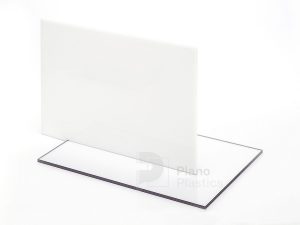
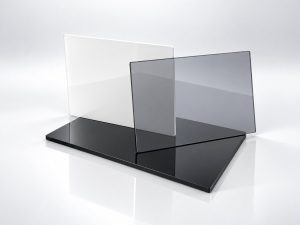
Clear in 2 to 15 mm, opals in 2 to 6 mm and smoke in 3 to 6 mm, all in 3050 × 2050 mm. Deviating colors, thicknesses and formats on request.
Is polycarbonate fire-resistant?
Yes, polycarbonate is self-extinguishing and has excellent flame-retardant properties.